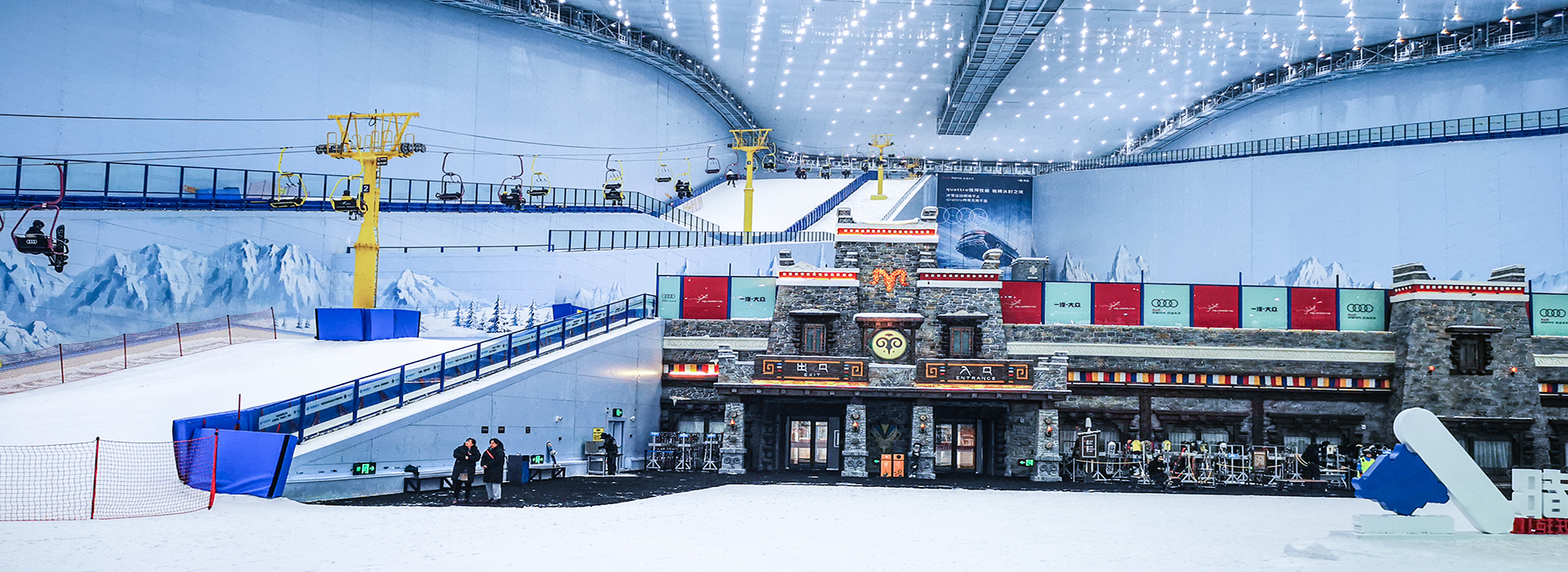
How many kWh a snowfall machine uses per hour depends directly on the input power of the complete unit: when running continuously at full load for 1 hour, a few kilowatts equals a few kilowatt-hours, that is, a few kWh. Coverage area, however, has no fixed value independent of operating conditions; installation height, temperature and humidity, airflow, target snow volume, and operating time all change the result. The principle of a snowfall machine can be summarized as “high-pressure water mist + ice crystal nuclei + low-temperature heat exchange”; when selecting equipment, calculate power consumption, snow volume, and equipment layout together—do not simply multiply an area figure by the number of units.
Snowfall Machine Principle: High-Pressure Water Mist Is Not Direct Snowmaking
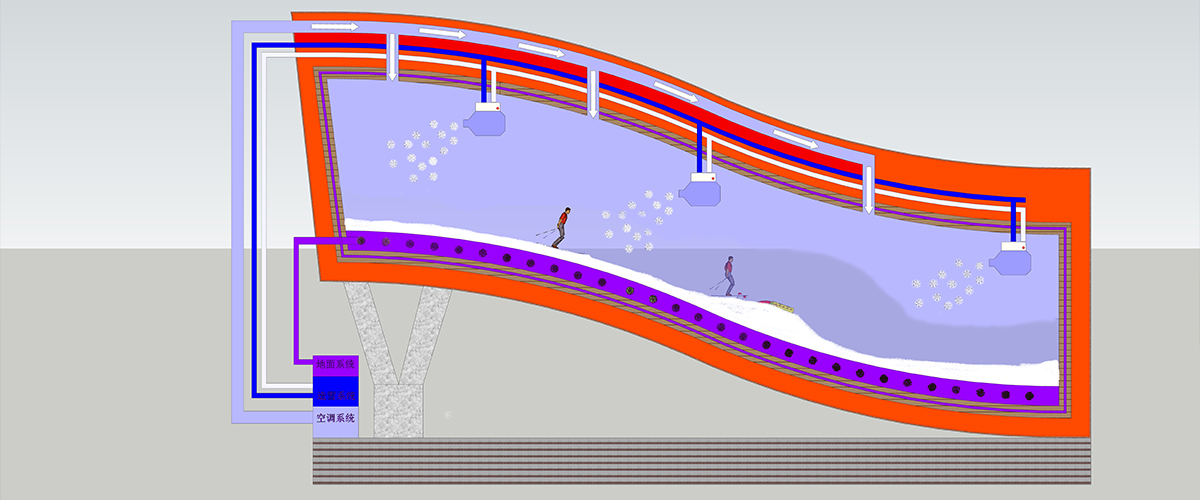
High pressure feeds water to the nozzle, where the water is atomized into small droplets; the nucleation section forms or introduces tiny ice crystals, providing ice crystal nuclei for the droplets. The droplets contact the ice crystal nuclei, continue to exchange heat and freeze in the low-temperature air, and eventually form snowflakes that can fall. High pressure mainly handles atomization and transport, not refrigeration directly; lower water temperature does not necessarily mean stable snow formation.
The key is whether the droplets complete the phase change before landing and whether the snowflakes fall into the target area. If ambient temperature is too high, humidity is too high, or airflow blows the droplets away from the target area, you may see “visible white mist but no snow on the ground,” or even only standing water on the floor.
For equipment categories, refer to indoor snowmaking machines, snow rooms, and real ice rink equipment. The technical agreement should still specify the project temperature and humidity, installation height, and target snow conditions; it is not advisable to simply copy the maximum coverage value from a brochure.
Snowfall Machine Power Consumption: Separate Equipment Power from Room Cooling Load
The hourly power consumption of a single unit running continuously at full load is:
E=P×1h
P is the total unit input power in kW; E is in kWh. 1 kWh is one unit of electricity. Do not use pump power in place of total unit power, and do not treat cooling capacity as power consumption.
When calculating the power consumption of a snow machine, also confirm whether the fan, pump, nucleation device, control system, and necessary heat tracing are included in P. The daily power consumption of multiple units can be estimated as follows:
E_day = N × P × He
N is the number of units in operation, and He is the equivalent full-load operating hours per unit per day. For intermittent start-stop or group operation, He should be determined according to the control strategy or operating records; if the units have different power ratings, calculate each unit separately and then add the results.
Room cooling and dehumidification are separate. The cooling required to freeze the droplets may be provided by the venue’s refrigeration system; looking only at the unit nameplate will underestimate the total project electricity consumption.
Coverage area and unit configuration: take the larger of two calculations
When selecting a snow machine, first perform a preliminary area calculation, then check the snow volume.
Let Ae be the effective coverage area of a single unit under the agreed operating conditions. It is the area that can achieve the target snow conditions, not the circle enclosed by the farthest spray point. The preliminary number of units by the area method is:
NA = round up (As ÷ Ae)
If an area of As square meters must form snow with thickness h within T hours, first calculate the target snow volume:
M = As × h × ρ
ρ is the design snow density, determined according to the target snow conditions. The required hourly snow volume is Q = M ÷ T. Let q be the effective snow production of a single unit under project conditions; then:
NQ = round up (Q ÷ q)
The final preliminary number of units N = the larger of NA and NQ.
| Configuration scenario | Area and snow-volume conditions | Initial unit count | Design action |
|---|
| Single-point trial snowfall | As ≤ Ae and Q ≤ q | 1 unit | Verify drop point, snow quality, and floor conditions |
| Two-unit zoning | Ae < As ≤ 2Ae and Q ≤ 2q | Start with 2 units | Check coverage overlap and airflow interference |
| Three-unit zoning | 2Ae < As ≤ 3Ae and Q ≤ 3q | Start with 3 units | Use group control and verify snow volume zone by zone |
| Two methods give different results | NA ≠ NQ | Use the larger value | Recheck installation height, obstructions, and operating time |
The table above is for preliminary calculation only. If only short-term visible snowfall is required and snow accumulation is not required, the snow-volume indicator should be confirmed by trial snowfall rather than by rigidly applying the snow accumulation formula. Column grid, air vents, and obstructions may block the snow-spray path, so the final unit count must also be adjusted according to the layout plan.
How to calculate a 1,200 m² indoor ice rink
For a 1,200 m² indoor ice rink, if the goal is only to add snowfall effects between operating sessions, first define the actual snowfall area; do not assume the entire ice surface will be covered at the same time. Then determine the duration of each session and whether snow accumulation is required.
Estimated by ice surface area, the cooling load of a standard indoor ice rink is 350-450 W/m², and this ice surface corresponds to approximately 420-540 kW of cooling capacity. This is the overall refrigeration basis for the rink, not the power of a single unit, and it cannot be used to directly convert to the number of units.
For every 1 m increase in ice rink clear height, the cooling load increases by approximately 3-5 percentage points. Raising the equipment suspension height also changes where snowflakes land, so the layout and room cooling load must be reviewed together. For projects involving the indoor ski slope business segment or the indoor snow house business segment, likewise first divide functional zones and operating periods, then determine the areas for continuous operation and intermittent operation.
Price Tiers: Low-Temperature Environment Modifications Must Be Listed Separately
When purchasing snowfall machines, the preliminary budget can be tiered by implementation scope; do not compare prices across different supply scopes.