Start with the conclusion: snow house cost per square meter can only be estimated at the schematic design stage. Mobile snow houses typically concentrate cost in demountable enclosures, integrated equipment, and transport and installation; fixed snow houses place more cost in permanent enclosure, foundation coordination, continuous insulation, and on-site utilities. The two cannot be directly compared using the same equipment list.
Before asking "How much does a snow house cost?", establish a common basis: this article calculates on the basis of the snow house's indoor floor area, including standard insulated enclosure, refrigeration and snowmaking, basic theming, and installation and commissioning. It excludes site lease, new main building construction, external power capacity upgrades, and large-scale fire protection modifications. If area, configuration, and exclusions differ, even a lower unit price is not comparable.
How snow house costs break down: five cost items must not be mixed together
Structure and foundation. A demountable mobile snow house requires a frame, enclosure, connection joints, and a prefabricated base. It usually reduces permanent foundation work, but the existing site's load-bearing capacity, leveling conditions, transport access, and lifting space still need to be verified. A fixed snow house must be coordinated with the existing building for floor slab, waterproofing, foundation details, and civil works. The upfront engineering scope is larger, and it is not suitable for frequent relocation later.
Insulation and sealing. For mobile solutions, the focus is sealing at panel joints, door openings, and after repeated assembly and disassembly; for fixed solutions, the focus is enclosure continuity, vapor barriers, moisture protection, and thermal bridge treatment. Comparing panel thickness alone is not enough. Any discontinuity at wall corners, the roof, pipe and duct penetrations, or entrances can lead to condensation, icing, and additional energy consumption.
Refrigeration and snowmaking. Snow room refrigeration cannot simply copy ice rink benchmarks. A standard indoor ice rink has a cooling load of 350-450 W/m², calculated based on ice surface area; a snow room must also take into account the target room temperature, door-opening frequency, heat gain from occupants, theming, and envelope conditions, and should be calculated separately. When reviewing indoor snowmaking machines, snow rooms, and other products, look at the terminal units, defrost and drainage, control system, plant room piping, and maintenance access at the same time—do not compare only the main unit.
Theming and interactivity. Basic snow effects, lighting, and simple shapes are not the same configuration tier as themed finishes, complex curved surfaces, and interactive installations. Mobile snow rooms must also limit the weight of the theming and allow for disassembly and reassembly; fixed snow rooms are easier to integrate deeply with the building and circulation flow, but on-site fabrication and finishing work are usually more extensive.
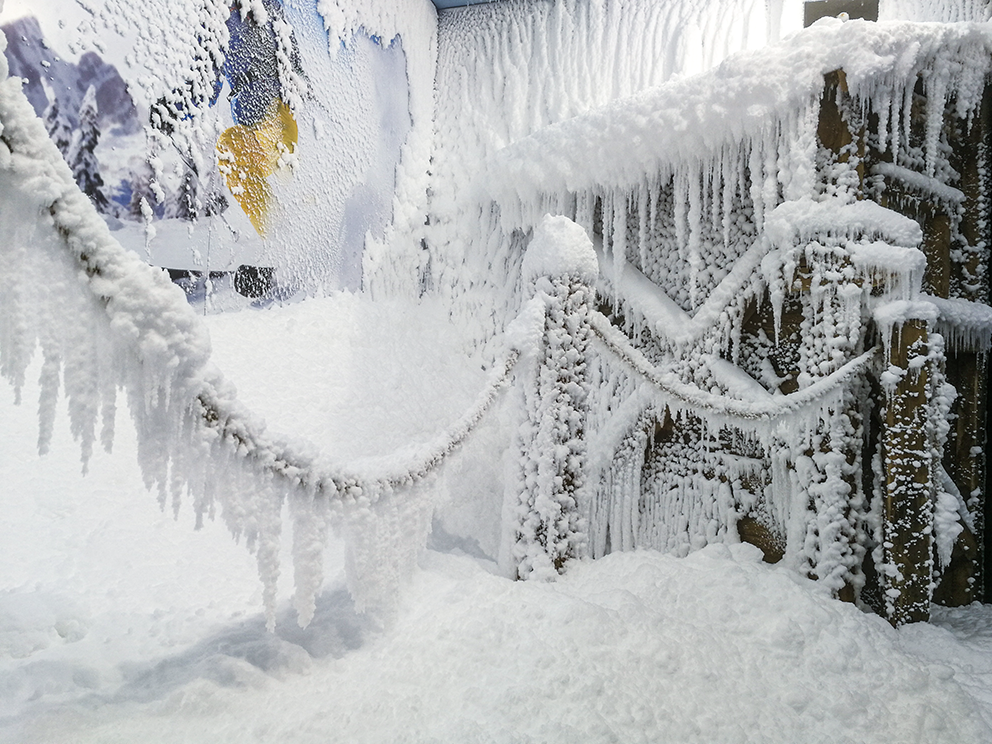
Installation and post-installation costs. The mobile solution must include transport, loading and unloading, and possible reinstallation; the fixed solution must include on-site construction, fixed piping, and building restoration. Only when costs are broken down this way can snow room pricing correspond to actual work quantities, instead of mixing equipment cost, construction cost, and theming cost into a single per-square-meter figure.
| Cost item | Main costs of a mobile snow house | Main costs of a fixed snow house | Key points to verify when comparing prices |
|---|
| Structure | Demountable frame, box units, connectors | Fixed enclosure, on-site sealing | Whether transport and installation are included |
| Foundation | Leveling, supports, prefabricated base | Floor slab, waterproofing, foundation coordination | Whether the existing site needs modification |
| Insulation | Panel joints, door openings, demountable sealing | Continuous insulation, vapor barrier, thermal bridges | Whether detailing is complete |
| Refrigeration and snowmaking | Integrated equipment, quick connections | Plant room, fixed piping, terminal units | Whether power distribution and drainage are included |
| Theming | Lightweight, demountable scenic elements | Theme design development, on-site fabrication | Scenery schedule and restoration boundaries |
Snow house cost per square meter: four configuration tiers
The snow house costs below are per-square-meter estimates at the schematic design stage, not fixed quotations. For smaller areas, costs such as units, controls, and transport are harder to spread; for larger areas with complex theming, the unit price may also increase.
| Type and Tier | Configuration Scope | Estimated Cost per Sq M Basis |
|---|
| Mobile snow house - basic tier | Standard insulation, basic temperature-controlled snowmaking, limited theming | Typically RMB 3,000-5,000 |
| Mobile snow house - themed tier | Full snowmaking, themed scenery, more interactive features | Typically RMB 4,000-6,500 |
| Fixed snow house - retrofit tier | Retrofit within an existing building, fixed enclosure, standard theming | Typically RMB 4,500-7,500 |
| Fixed snow house - comprehensive tier | New fixed enclosure, complex theming, complete fixed ancillary systems | Typically RMB 6,500-10,000 |
Snow house costs under this basis do not include new construction of the main building, site leasing, external power capacity upgrades, or large-scale fire protection modifications. They vary with configuration and are ultimately calculated on a project-by-project basis. Lower price tiers for mobile snow houses usually result from reduced fixed foundations and building restoration, and do not mean that insulation or refrigeration can be downgraded. For fixed solutions, the overall scope of indoor snow house design and construction should be used to list the enclosure, equipment, and construction clearly in one go.
Common Scenario: Why Total Costs Differ for the Same Area
Using a 300 sq m indoor snow house as a general estimate, assuming the existing building can be used normally and no new main structure is involved: under the mobile snow house basic tier, the corresponding total is typically RMB 900,000-1,500,000; under the fixed snow house retrofit tier, the corresponding total is typically RMB 1,350,000-2,250,000. These vary with configuration and are ultimately calculated on a project-by-project basis.
This cost difference for a generic snow house scenario does not indicate a higher or lower equipment grade. The former includes a demountable structure and integrated installation, while the latter includes more fixed enclosure, foundation coordination, and on-site piping and wiring. If complex themed scenery, an entrance vestibule, or insufficient power and drainage conditions at the original site are added, the list should be re-adjusted; the original per-square-meter figure cannot continue to be applied.
Three Selection Questions: Don't Compare Only Mobile Snow House Prices
Question 1: If your site is a temporary exhibition area in a shopping mall, an indoor space with a short lease term, or an operating location that may be adjusted, choose a mobile snow house. Its value lies in being demountable, relocatable, and requiring minimal modification to the original floor. First check the transport access, floor load capacity, power supply, and drainage—don't just ask how much a snow house costs; over a short cycle, the construction and demolition/restoration investment of a fixed solution is often difficult to amortize.
Question 2: If your site is an indoor park that is held long-term and whose visitor flow and theme have already been determined, choose a fixed snow house. A fixed solution makes it easier to thoroughly handle continuous insulation, thermal bridges, the equipment room, drainage, and maintenance at one time, and also facilitates integrating themed scenery with the building's circulation. The prerequisite is to confirm fire protection, power distribution, and enclosure conditions before construction, to avoid having to supplement the works after the equipment arrives.
Question 3: If your site is a mixed-use space intended for long-term operation but whose area, theme, and reception pace have not yet been validated, choose an expandable mobile snow house and first control the scope of civil engineering modifications. When comparing mobile snow house prices, also list transport, disassembly/assembly, reinstallation, and site restoration costs; whether to convert to a fixed solution later should be recalculated based on operational needs.
Conclusion: Put Snow House Cost into the Operating Cycle
First confirm the site's service life, whether it will be relocated, and the area basis, then decide between mobile and fixed—do not use the lowest per-square-meter price as the procurement basis. Have the proposal itemized by structure, insulation, refrigeration, scenery, foundation, and installation, and clearly state whether power distribution, drainage, transport, and disassembly/assembly are included. For mobile solutions, focus on calculating relocation and reinstallation; for fixed solutions, focus on enclosure continuity, thermal bridge treatment, and long-term maintenance; then compare total investment over the operating cycle. When calculating snow house cost, review the load and configuration according to the target room temperature, door-opening frequency, and scenery list; it fluctuates with configuration and is ultimately calculated on a project basis.